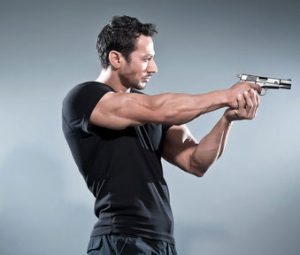
An IT consultant from Great Britain has become the center of a strange and drawn-out legal ordeal after sharing a photo on social media of himself while on vacation holding a shotgun in Florida.
Upon returning to the UK, he was arrested by police, not for any wrongdoing in America, but for what the image “might make people feel.” The case has stirred outrage and sparked a broader debate about policing, free speech, and social media in modern Britain.
According to the Telegraph, 50-year-old IT contractor Jon Richelieu-Booth, from West Yorkshire, posted a photo on LinkedIn on August 13, 2025, showing himself on vacation in Florida holding a shotgun at a friend’s private homestead. He says the caption on his post simply described his day and work activities; there was no threatening language or suggestion of violence. Within days of posting, police officer visited his home. Authorities “warned” him about the post, urging him to “be careful what I say online, and I need to understand how it makes people feel.”
Yet the warning was only the beginning. On August 24, approximately a week after the LinkedIn post, Richelieu-Booth was arrested at around 10 pm. The bail documents listed allegations of “possessing a firearm with intent to cause fear of violence”, as well as a stalking allegation tied to a different photo of a house on his profile. Richelieu-Booth says he even tried to provide geolocation metadata to prove the shotgun photo was taken in Florida, but police reportedly told him that was “not necessary.”
After being held overnight and interviewed, Richelieu-Booth was released on bail, only to endure repeated police visits and the seizure of his computers and phones. As a self-employed IT contractor, he said the seizure destroyed his ability to work.
Over the 13-week period that followed, the case seemed to unravel. The original firearms and stalking allegations were withdrawn. But that was just the beginning.
He was conveniently later charged with a public order offense tied to a different social media post allegedly “displaying visible representation with intent to cause harassment, alarm or distress.” The charge, which carried a potential six-month jail sentence, was due to be heard at a magistrate’s court. But on November 18 the prosecution dropped the case, declaring there was “not enough evidence to provide a realistic prospect of conviction.”
In a statement to the media, Richelieu-Booth called the ordeal “massive overreach,” describing his weeks in limbo as “13 weeks of hell.” He expressed deep frustration and announced plans to sue the police for damages.
Richelieu-Booth said the case has left him disillusioned with law enforcement. “I thought 1984 was a book, not an instruction manual,” he told the press.
For many, the arrest over a vacation photo has been seen as a stark example of law enforcement overreach that punishes expression rather than crime.
Observers note that while the gun in the photo was legally handled in the US, the post contained no explicit threats the mere appearance of a firearm seemed enough to trigger criminal proceedings. Critics say the case illustrates how modern policing can be driven by subjective perceptions of what social-media posts might “make people feel,” rather than objective wrongdoing. The decision to arrest and then prosecute a law-abiding UK citizen for what amounts to an image raises pressing questions about the boundaries of free expression, personal history, and public-order laws.
The incident also highlights the contrast between gun laws in the UK and the US.
In much of America, recreational use of firearms on private land is common, legal, and photographs of such are rarely questioned. But in the UK, firearm possession is strictly regulated, and public attitudestoward guns tend to be more sensitive. As what began during the COVID era, and now ever-increasing, UK police are using public-order legislation to prosecute social-media content; a change that worries civil-liberties advocates. Authorities say they are acting to prevent harassment, intimidation or the potential of violence.
For now, the case stands as a cautionary tale: even when an image is taken legally abroad and meant innocuously, the act of posting it online in Britain may carry unforeseen legal risk. In an age where every vacation selfie or gun-range photo can be shared broadly, and instantly judged, the boundaries between lawful expression and criminal suspicion may be narrower than many assume. Thankfully, the Founding Father’s ceased to care about British firearm laws and drafted the Second Amendment to prevent such overreach.
Editor’s Note: This Orwellian nightmare could be a taste of our future if we don’t defend our Second Amendment rights.
Help us continue to expose the gun control lobby’s attacks on those rights with news you can trust. Join Bearing Arms VIP and use promo code FIGHT to get 60% off your membership.
Read the full article here