Alabama rigs, also known as A-rigs or umbrella rigs, can seem intimidating if you’ve never thrown one. There are wild wires and blades everywhere, multiple soft plastics, and the thing looks like a chandelier. It certainly doesn’t look like something you just tie on and cast, which is true, but avoiding the A-rig is a big mistake.
The fact of the matter is, A-rigs are one of the most effective bass fishing lures ever created. You can slow roll it in deep water, burn it around shallow structure, twitch and pop it, and everything in between.
Its versatility and effectiveness are unmatched. It is hands down my favorite way to fish in the cold months, but it’s great for year-round bassin’. The A-Rig allows you to power fish, cover water, and, more importantly, catch absolute giants. And don’t think it’s just for big fish. You can catch some serious numbers with it as well.
Fortunately, it’s not as complicated as it seems. So, without further ado, let’s dig into the mighty umbrella rig. I’ll break down what you need, what you don’t, how to rig it, and effective fishing strategies.
What You Need for an A-Rig
Unfortunately, from a rigging standpoint, Alabama rigs are gear-intensive. The options for rigging are quite literally endless, but you can limit your selection to be effective and fish with confidence.
Below are the rigging options I keep on my boat to keep it simple, along with the rods, reels, and lines I use to throw it.
A-Rigs
The Rig for Anglers on a Budget
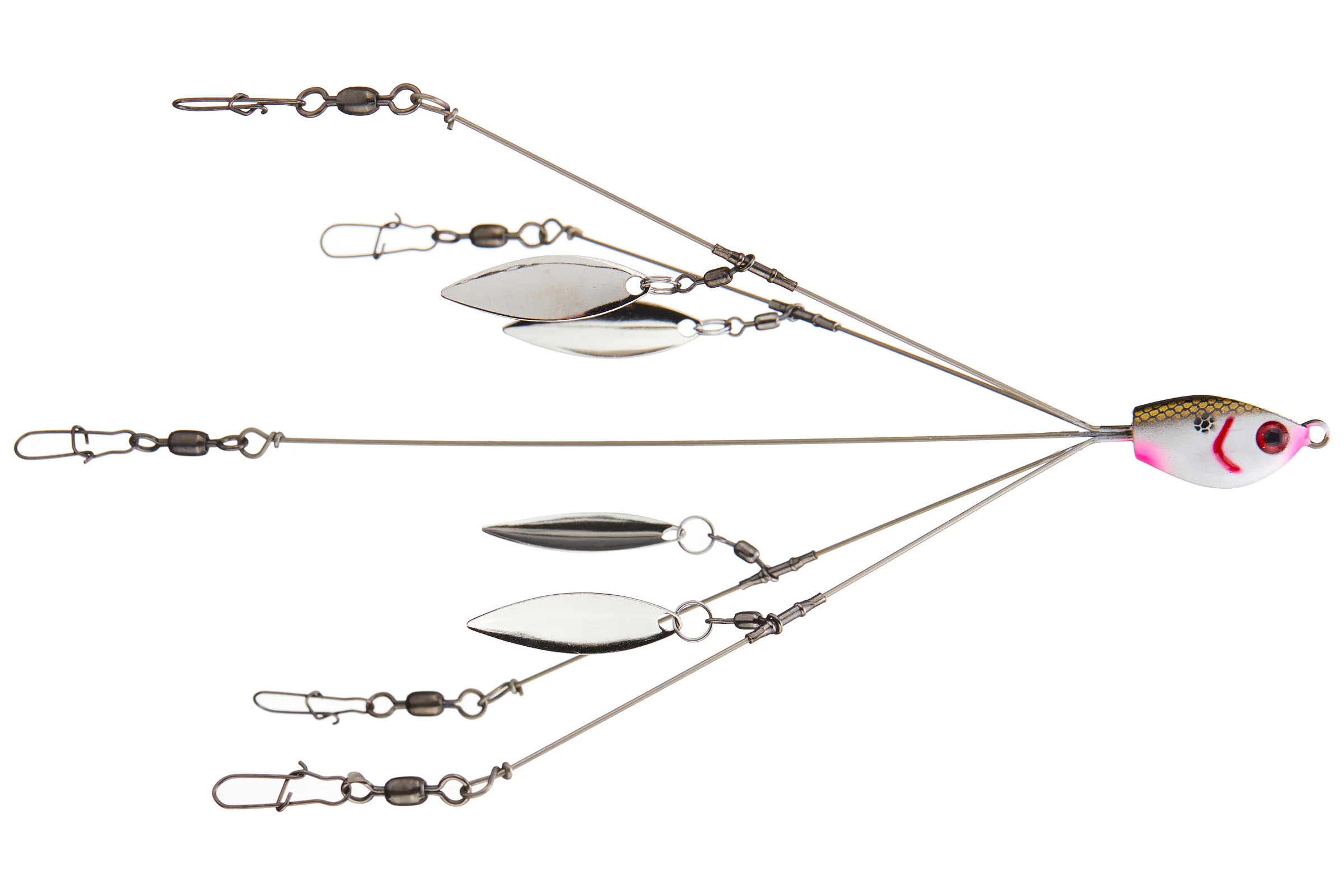
For those who are just getting into A-rigging, it’s tough to beat the YUM Flash Mob Jr. It’s cheap in the world of A-rigs at 15 bucks. You won’t question your entire existence if you break it off on a submerged structure.
But don’t let the price fool you. The dang thing fishes. Even though I have more expensive rigs on my boat, I still turn to this one, especially when I’m fishing in snaggy areas.
This is a great option because it’s relatively compact and weighs under half an ounce. You don’t need specialized equipment to throw it. Selection is simple with only two versions: one with four willow blades, or one with four Colorado blades. To top it off, they’re available almost everywhere. I’d be willing to bet there’s some for sale at your nearest Walmart.
Sometimes I swap out the included snaps for higher-quality aftermarket hardware because I don’t want the fish of a lifetime to come off because of a crummy snap. However, that’s certainly not a necessity, and I have successfully fished it straight out of the pack.
The Easiest Rig to Set Up
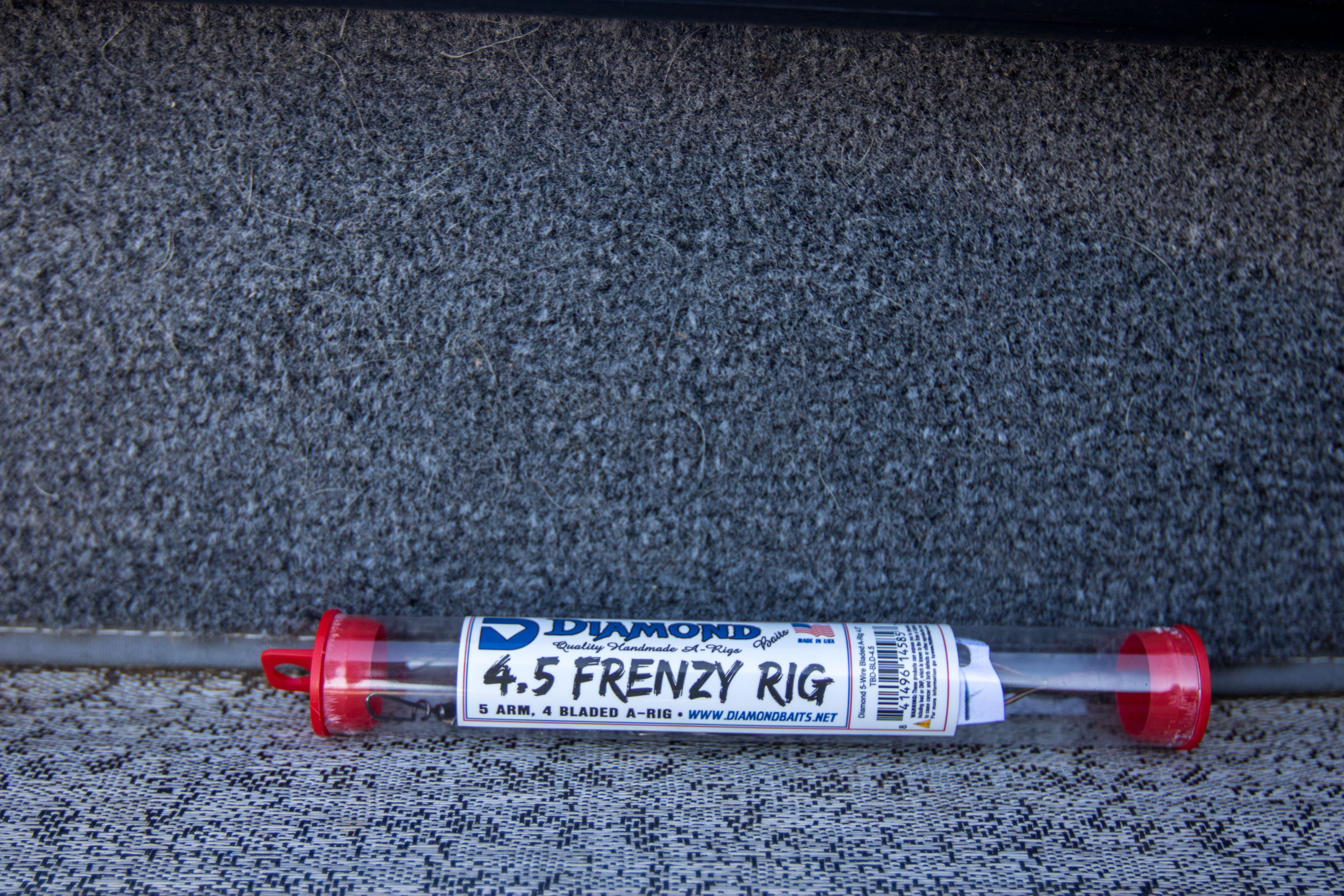
If you’re willing to spend a few more bucks and want the easiest A-Rig to set up, check out the Diamond Baits 5 Wire Bladed Alabama Rigs (~$20). My personal favorite is the 4.5-inch “Frenzy Rig” due to the castable size.
These rigs are the easiest to set up because they come with the arms pre-bent out. Diamond clips two of the arms together with the swivels and packages them in a small tube. All you have to do is remove it, undo the snap, and the arms spring out, ready to go. Clip some jig heads to it, and you’re off to the races.
The hardware is high quality, with a 220-pound swivel head and 75-pound snaps. Unless you want to replace the snaps with split rings, there’s no need for hardware upgrades.
The only downside is that the Diamond Baits A-rigs can be a little tougher to find, but they are one of my absolute favorites. There is a wide variety of sizes and blade options, and they catch ’em. They’re one of the best bang-for-the-buck A-rigs on the market.
The Most Versatile Rig(s)
For those who need any variation of an A-rig under the sun, the options from Hog Farmer are endless (~$25 depending on model). In addition to the options above, I carry three from Hog Farmer: the Tactical Bassin Flex Rig, the Tactical Bassin Mini Flex, and the Tactical Bassin Micro Flex.
All three of those cover my bases in different sizes, and all are available in bladed or non-bladed versions. I usually start off with the bladed versions, but turn to the non-bladed versions in clear water or anytime a subtle presentation is needed.
Each one of those A-rigs comes standard with snap swivels for your baits and hitchhikers in place for dummy baits. If you don’t like the snap swivels, Hog Farmer also includes replacement Owner split rings in each package. That’s a nice touch that helps justify the higher prices.
And if those three options aren’t enough for you, Hog Farmer has countless others, with different numbers of wires, blades, and sizes.
Jig Heads
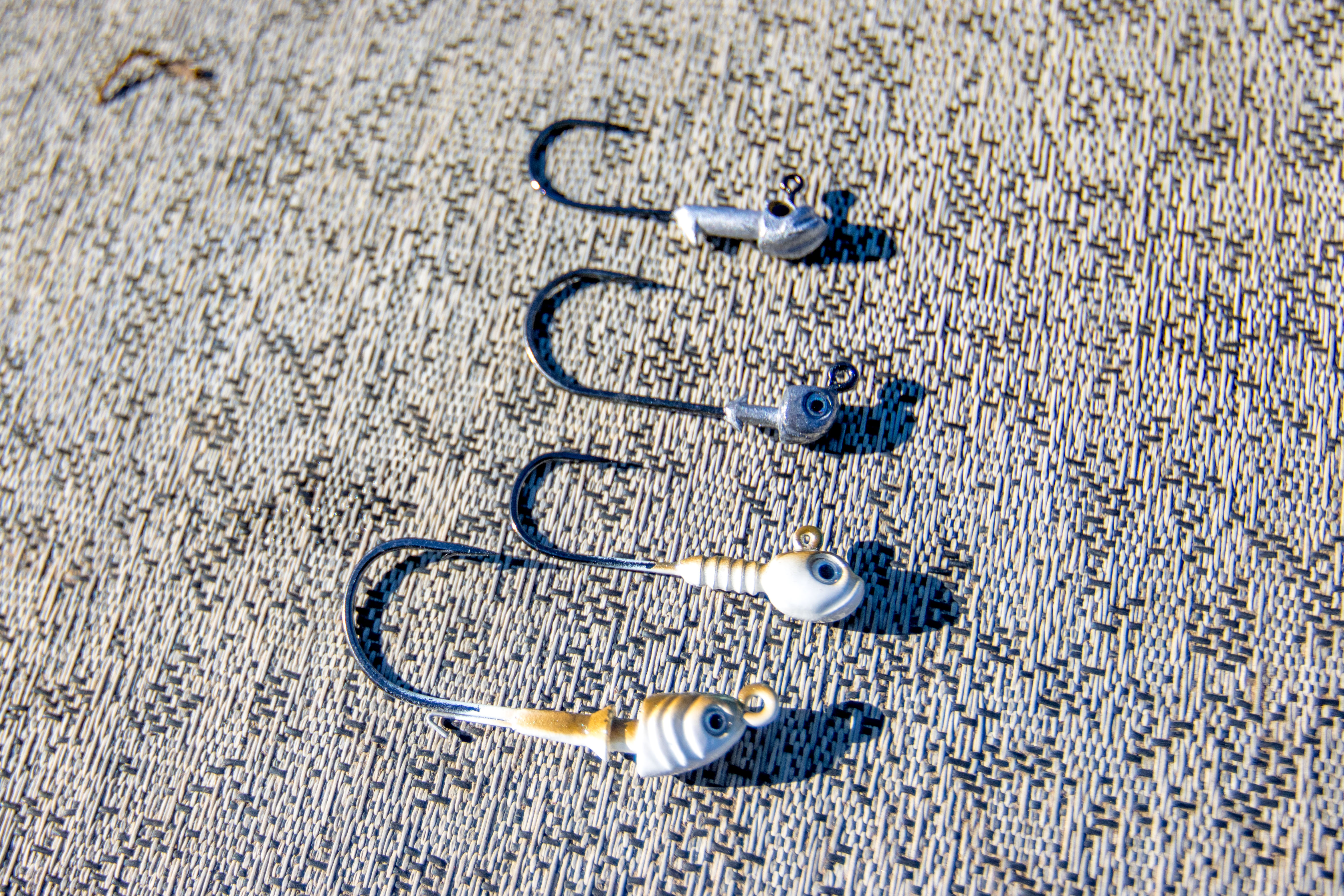
After you’ve selected the rig you want to throw, it’s time to pick out jig heads to attach to it. I prefer to use three different jig-head sizes on an A-rig: 1/8 ounce, 3/16 ounce, and 1/4 ounce. Any bigger than that and the rig becomes ridiculously heavy and difficult to cast.
The trick is finding a jig head in those smaller sizes that has a long enough hook to thread a full-size swimbait on and uses heavier-gauge wire. It doesn’t have to be a gaff, but I prefer stouter hooks for bigger fish, and for those times you get doubled up. Here are some of my favorites:
- VMC Boxer Jig
- Picasso Lures Smart Mouth
- Dirty Jigs Guppy Head
- Dirty Jigs Matt Allen Swimbait Head
Generally, I fish 1/8-ounce and 3/16-ounce heads, and only bump up to 1/4 ounce if I’m fishing giant A-rigs or plan to fish water deeper than 20 feet. When it comes to A-rigs, I have zero color preference on jigheads. I’m of the opinion that there’s no way fish care about something as subtle as color on a small jig if they’re eating an A-rig.
Swimbaits
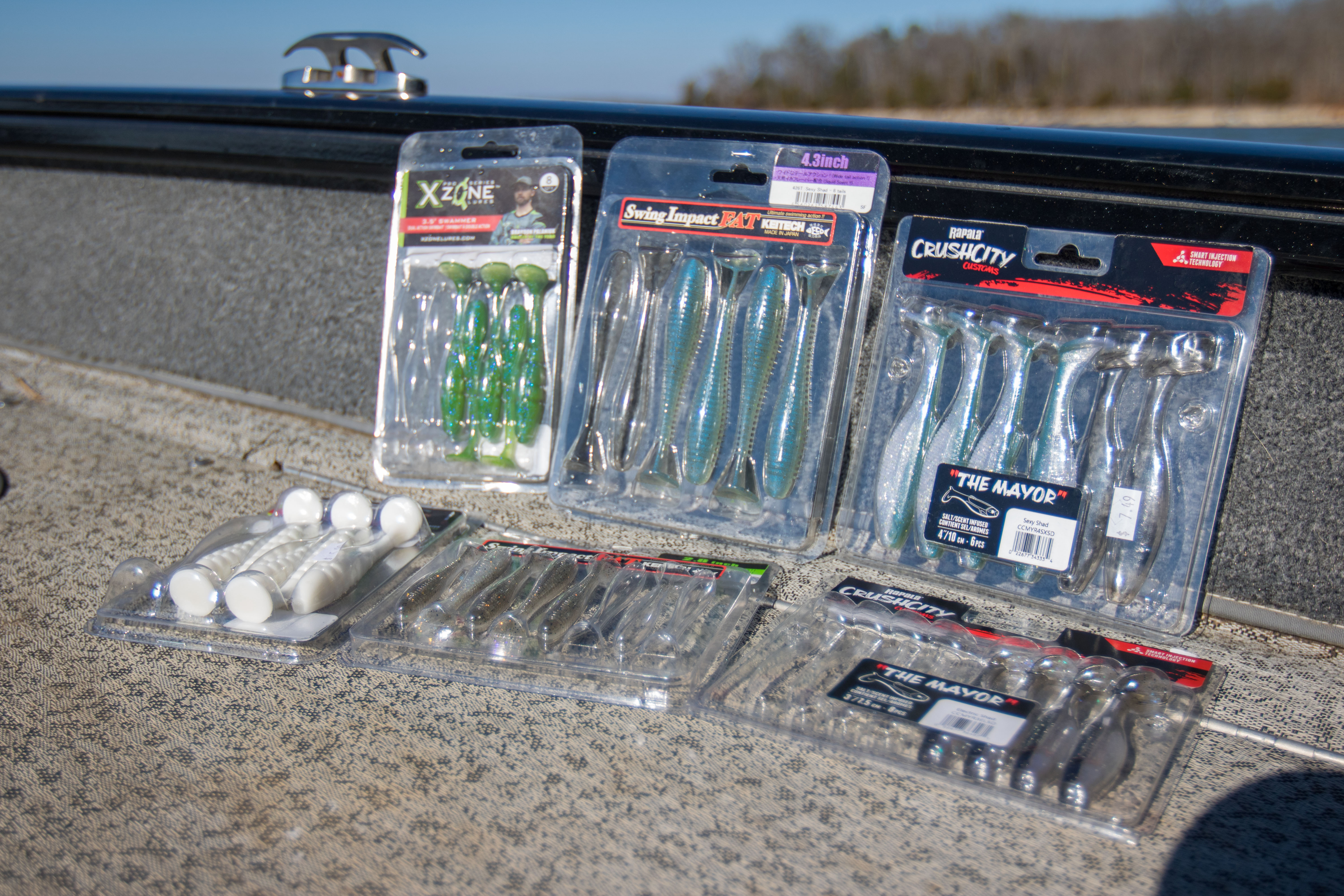
There are countless swimbaits you can throw on an A-rig, but really, you just need two different types for year-round A-rigging. You want one option with an aggressive action, and another option with a tighter, more subtle action. There are three that I consistently use.
When it’s cold, and I want subtle action, I lean on the Rapala Crush City “The Mayor.” If I’m looking for an aggressive kicking action, I either select the Keitech FAT Swing Impact or the X Zone Swammer.
You will need a range of sizes. I start at roughly 2.5″ for “dummy baits” or use on smaller rigs, and go up to 4.5″ for larger rigs. If I were new to the game and just getting into it, I’d get swimbaits in 3″ and 4″ only. You don’t have to run the gamut.
The sky is the limit on colors, but I tend to stick with natural shad colors and white. However, for the larger baits that actually have hooks, I like to mix in baits with brighter colors like chartreuse or bright blue, “sexy shad” hues. That little pop can give the bass something to hone in on.
Rods, Reels, and Lines for A-Rigs
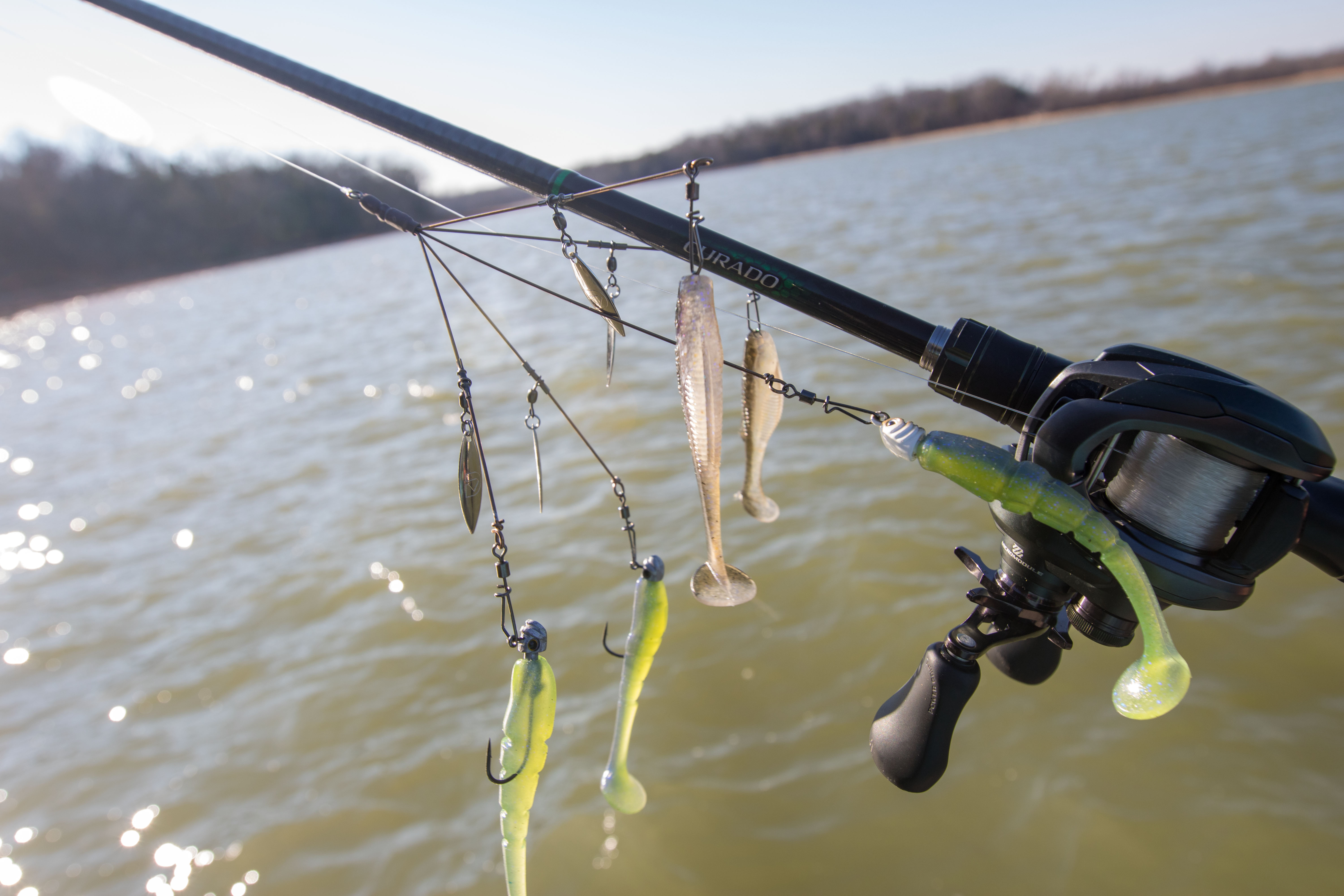
You may be surprised to hear this, but you don’t need specialized equipment to throw A-rigs. Chances are, you probably have a rod you can use.
A rod like the 7’5″ Heavy Powered Fenwick Elite is perfect for throwing any A-rig under the sun. You want something that has enough power to throw big rigs, but it doesn’t have to be a broomstick. Most heavy-action rods are perfect, and I prefer one with a parabolic action.
If you don’t have that long or heavy of a rod, don’t stress about it. I throw A rigs often on medium-heavy to heavy-powered 7′-7’3″ jig rods and do just fine. Don’t be worried to go over your rod’s lure weight rating by a bit.
I prefer a reel with a slower gear ratio in the 6.3:1 realm, but again, don’t stress if you don’t have that. If you’ve only got a higher gear ratio, you’ll be just fine. You’ll just have to slow down your retrieve a touch.
Most of the time, I stick with 17-20–pound fluorocarbon line. It sinks well when I’m fishing deep, and I like the stealthiness in low, clear water.
If I’m fishing around structure or using a more expensive A-rig, I switch to 50-65–pound braid. I don’t think the braid spooks fish; we are fishing with a chandelier, after all. But it does make it more likely that I’ll bend a hook out rather than break my rig off whenever I get snagged.
A-Rig Rigging Tips
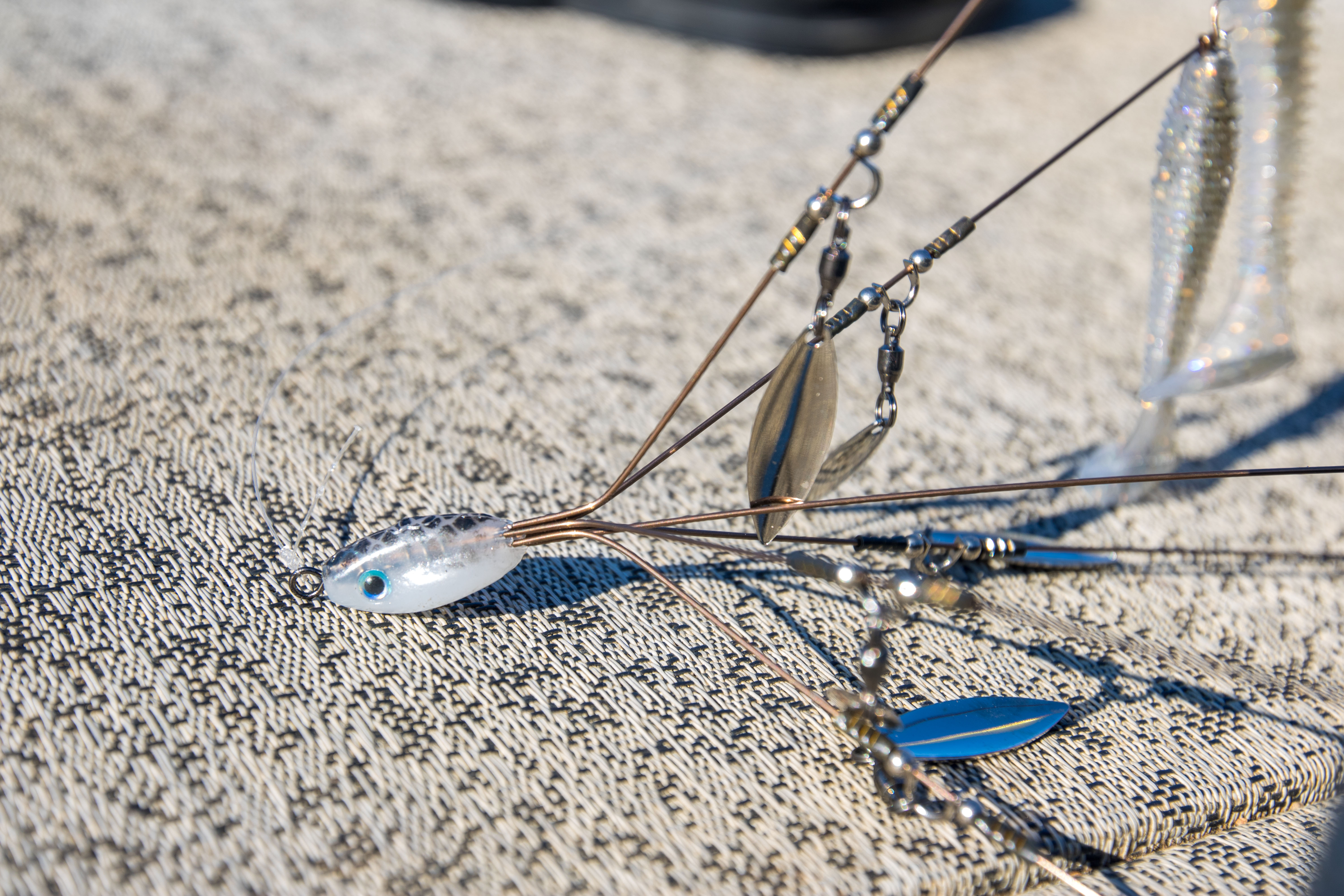
Now that you’ve got everything you need to get on the water, you need to set it up. Here are some pointers to save you a few headaches.
Dealing With the Wires
If you get an A-rig that requires you to bend the wires out, which most do, it matters where you bend the wires.
Do not bend the wires straight out of the back of the head. Leave about a half-inch of straight wire behind the head, and bend the arms from there. If you bend them right behind the head, the wires become ridiculously weak and will break when you hook a big fish.
Putting Baits on the Rig
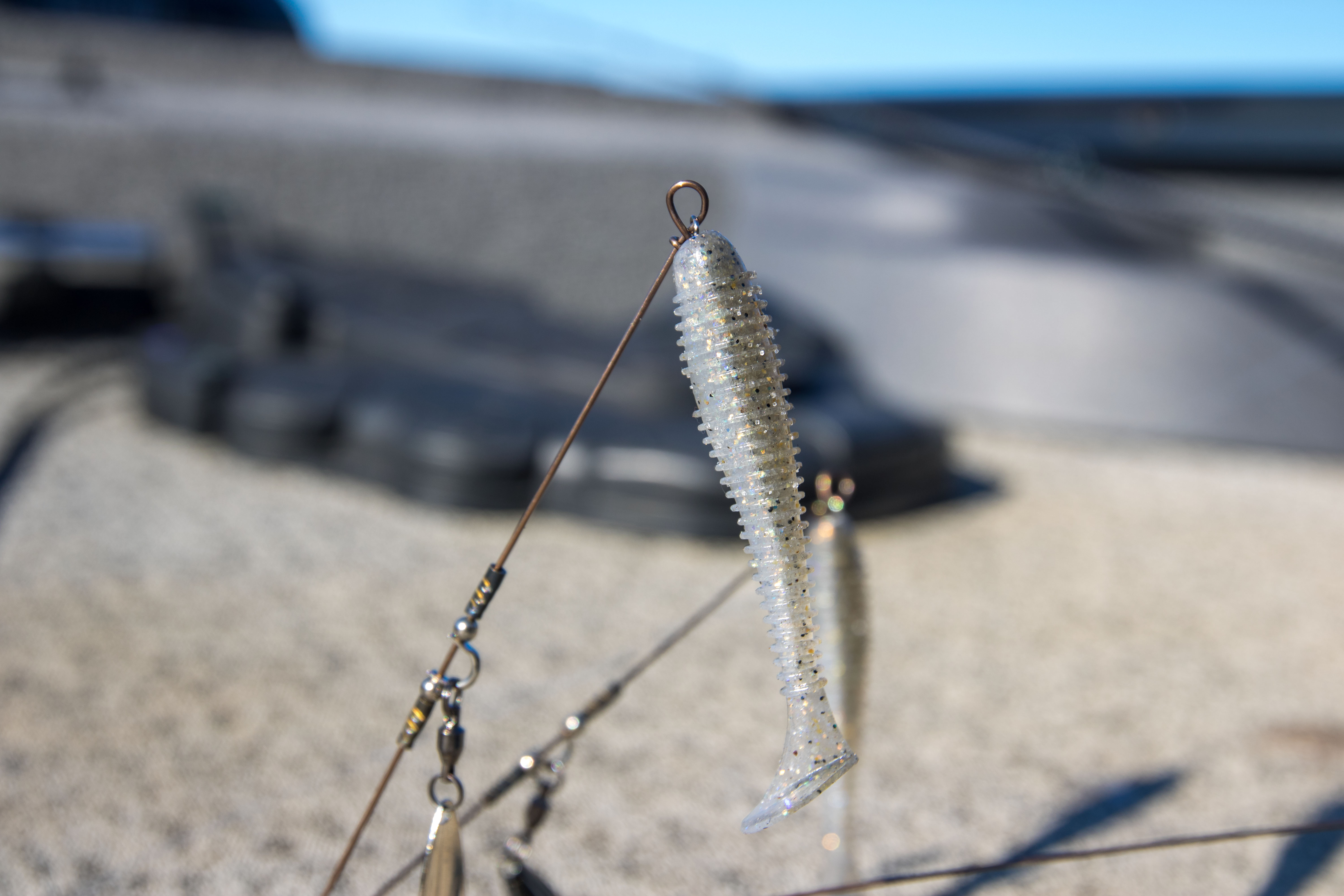
Many states have hook restrictions, so check to see how many hooked baits you can have on an A-rig. Most states allow three. Most A-rigs have five or more arms, so you’ll need to attach hookless baits.
Some people clip hook points off jig heads and attach “dummy baits” that way. I don’t like doing that, because it adds additional, completely unnecessary weight to the rig. And jig heads are spendy nowadays.
Instead, buy some hitchhikers and attach those to the top arms of your A-rig. You can nose thread soft plastics right onto them, and they’ll stay put.
Always, and I mean always, attach your hooked baits to the lower arms of your A-rig. That’s for two reasons: first, it puts the heavier jig heads on the bottom and will ensure your rig rides correctly in the water column. Second, bass will eat the bottom, lowest baits in your imitation bait ball every single time. I’m not sure why, but that’s how bass attack bait balls. Be sure those lower baits are the ones with hooks in them.
To further attract bass to my hooked lures, I like to place my larger swimbaits on my jig heads and downsize the swimbaits at the top. I’ll usually throw 4″ baits on top, and stick 2.5″ or 3″ baits up above. That also helps keep total rig weight down.
Other Rigging Tips
When it comes to bait colors, I think it pays to add a little pop to your rig. Oftentimes, I’ll put a single bait with a bright color in the middle of my bait ball, and it’s always hooked. It gives bass something to key on, and I think it adds some drawing power to the rig as a whole.
Lastly, if you want a higher landing percentage, replace the included snap swivels with split rings. There is a chance that a fish can open up a snap swivel. Yes, the odds are low, but it can happen. But there is a 0% chance that a split ring will open.
It’s not entirely necessary, and I don’t always do it, because rigging and swapping baits becomes more time-consuming with split rings. But if you want the most sure-fire way to land the big one, it’s worth the extra steps.
Final Thoughts: How to Fish an A-Rig
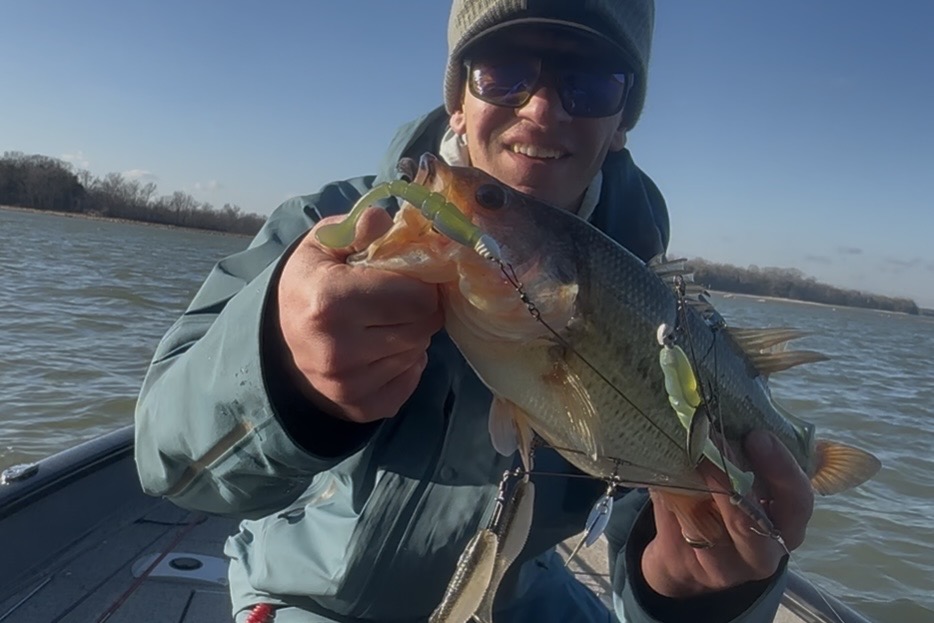
The best part of A-rigs is how versatile they are. You can chuck them in channel swings in the dead of winter, let them sink in 20-plus feet of water, and slow roll them on the bottom. Since there’s so much weight, they get down quickly.
They also belong in shallow water. I’ve had some awesome days running them next to laydowns, with bass coming out and absolutely crushing my phony bait ball. Or, you can burn them over shallow flats. As long as you’re not fishing in heavy vegetation, an A-rig deserves a shot.
When it comes to retrieves, experimentation is key. I usually start by steadily retrieving and occasionally pumping my rod tip. The pumps cause the rig to collapse on itself and then expand, which is exactly what schools of baitfish do when being chased. Often, you’ll get a grab right when you add in that secondary action.
But, if that’s not working, I change it up. I go fast, I go slow, and even occasionally pop and jig it off the bottom. Try whatever you’d like. When I’m out on the water, I never know what retrieve bass want on that particular day.
I do know one thing, though: Largemouth, smallmouth, and spotted bass will all commit. A well-presented A-rig is just too much to resist.
Read the full article here