The United States is now in what defense leaders call major combat operations against Iran, though Defense Secretary Pete Hegseth said that does not equate to “endless war” and another top Pentagon official said it’s “just the beginning.”
Hegseth and Chairman of the Joint Chiefs of Staff Gen. Dan Caine briefed reporters and the nation on Monday morning at the Pentagon, detailing the large-scale air and naval campaign launched early Saturday morning under direct orders from President Donald Trump and named Operation Epic Fury.
U.S. forces struck more than 1,000 targets in the first 24 hours. Officials said the military was roughly 57 hours into the operation at the time of the briefing and warned the campaign will take time.
Caine described the opening hours as one of the most complex joint operations in recent memory.
“This work is just beginning,” Caine said.
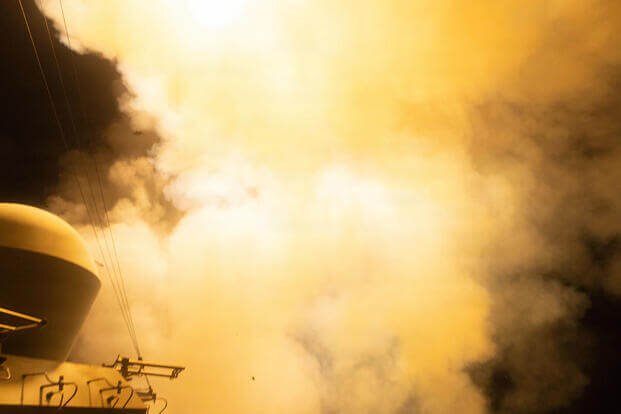
More than 100 aircraft launched at H-hour from land bases and carrier decks in a synchronized wave. Fighters, refueling tankers, airborne early warning aircraft, bombers and unmanned systems moved together. U.S. Navy destroyers fired Tomahawk cruise missiles. U.S. Cyber Command and U.S. Space Command disrupted Iranian radar and communications before and during the strikes.
The stated goals are clear: destroy Iran’s offensive missile systems, dismantle missile production, strike naval capabilities, and ensure Tehran never obtains a nuclear weapon.
Hegseth Rejects Iraq Comparison
Hegseth pushed back on comparisons to Iraq and Afghanistan, arguing the campaign is not a regime change effort or long-term occupation.
“This is not endless war,” he said. “This is not Iraq. This is not nation building.”
He refused to set a timetable.
“I would never hang a timeframe,” he said when pressed on how long operations may continue. “We will execute on the president’s terms.”
Lawmakers from both parties have called for classified briefings and signaled they will examine the administration’s authority under the War Powers Resolution. Hegseth did not address specific legal provisions during the on-camera session.
Warplanes, Carriers and Cyber Power Hit Iran
The Pentagon said more than 1,000 targets were hit in the first 24 hours. Leaders confirmed tens of thousands of pieces of ordnance have been delivered since operations began.

Two carrier strike groups—USS Gerald R. Ford and USS Abraham Lincoln—are operating in the region. The Ford’s extended deployment and rapid repositioning toward this crisis has been a key readiness signal as tensions climbed.
The Pentagon also confirmed the loss of three U.S. Air Force F-15E aircraft overnight. Caine said the jets were not downed by hostile fire and that the incident remains under investigation.
Commercial air travel and regional basing have also come under pressure as the conflict widens across the Middle East.
US Deaths Confirmed, More Likely
Hegseth confirmed that four Americans have been killed since the operation began and said additional losses are expected.
“As the president warned, an effort of this scope will include casualties,” he said.
He described one strike in which an Iranian missile penetrated layered air defenses and hit a fortified tactical operations center. He did not identify the location.
Pentagon officials said U.S. and partner air defenses have intercepted hundreds of ballistic missiles and one-way attack drones since the campaign began. Qatar, the United Arab Emirates, Kuwait, Jordan and Saudi Arabia are operating air defense systems alongside U.S. Patriot and Terminal High Altitude Area Defense (THAAD) batteries.
Iran has also demonstrated its reach by striking near the U.S. Navy’s Fifth Fleet headquarters in Bahrain, according to regional reporting tied to the same escalation cycle.
There are no American boots on the ground inside Iran, Hegseth added. He declined to outline limits on future action.
“Why in the world would we tell the enemy what we will or will not do?” he said.
U.S. Central Command has described the campaign as a coordinated air, maritime and cyber operation across multiple theaters, emphasizing force protection, regional air defense integration and sustained strike sequencing against missile infrastructure.
The War Powers Resolution requires the president to notify Congress within 48 hours of introducing U.S. forces into hostilities and limits deployments to 60 days without congressional authorization, unless lawmakers approve an extension or declare war.
Read the full article here