When the four-person Artemis II crew returned to Earth on Friday, they were welcomed by none other than four U.S. Navy sailors.
The Artemis II crew returned April 10 following a 10-day mission of flying around the moon, predicated on better understanding life support systems, spacecraft, and preparing for future lunar surface missions to both the moon and Mars. It was NASA’s first crewed lunar flyby in 50 years.
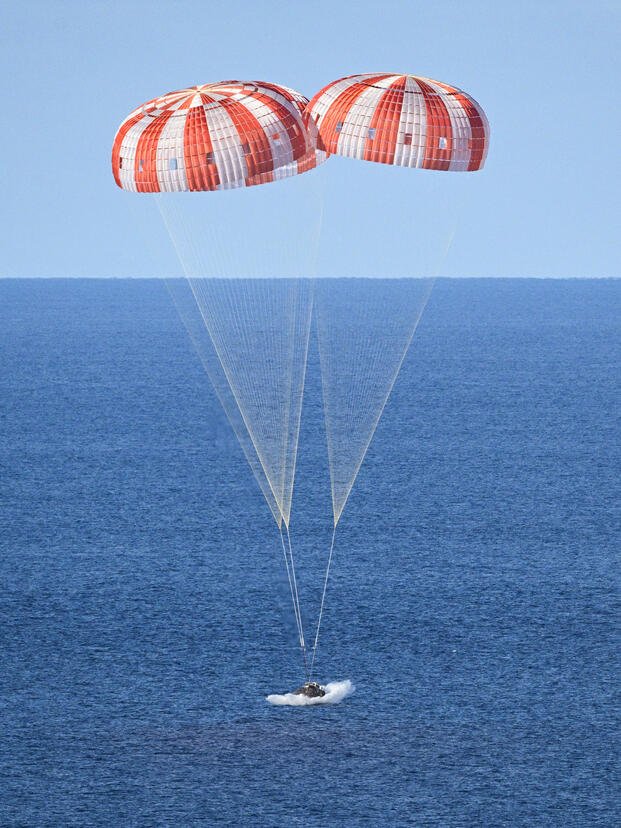
Four Navy sailors composed the dive medical team who were the first to open the Orion capsule upon its return to Earth, when it splashed down off the coast of San Diego at approximately 8:07 p.m. on Friday, April 10: Lt. Cmdr. Jesse Wang, Senior Chief Hospital Corpsman Laddy Aldridge, Chief Hospital Corpsman Vlad Link, and Hospital Corpsman 1st Class Steve Kapala.
They conducted the initial medical assessments of the Artemis II crew and assisted them out of the capsule safely and efficiently, according to the Navy. It’s not out of the ordinary for the sailors who are conditioned to work in such environments due to expensive specialized training that leads to diver certifications, understanding decompression illnesses and other underwater medical necessities.
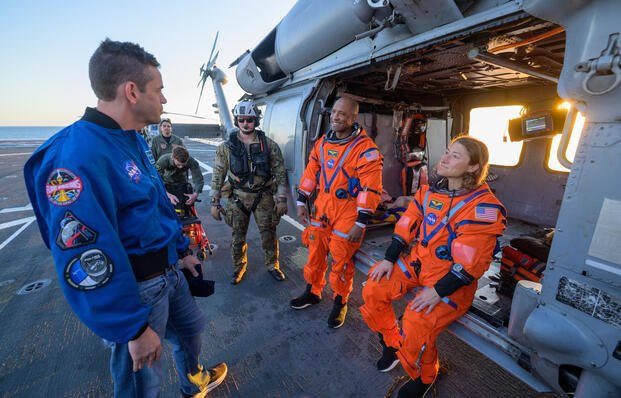
The Artemis II crew they tended to included Reid Wiseman (commander), Victor Glover (pilot), Christina Koch (mission specialist) and Jeremy Hansen (mission specialist). The crew included the first woman and first person of color to travel to deep space.
Artemis II launched on April 1 from Kennedy Space Center’s Launch Complex 39B in Florida.
The four astronauts aboard Artemis II made history at 1:56 p.m. ET on Monday, April 6, when they reached 248,655 miles from Earth—surpassing the farthest distance ever traveled by humans, a record previously set by Apollo 13 in 1970, according to NASA.
‘Culmination’ of Training and Navy Procedure
The four Navy service members entered the capsule after Orion’s reentry into Earth’s atmosphere and Pacific Ocean splashdown, reportedly entering the capsule to conduct initial crew exams and provide any necessary triage.
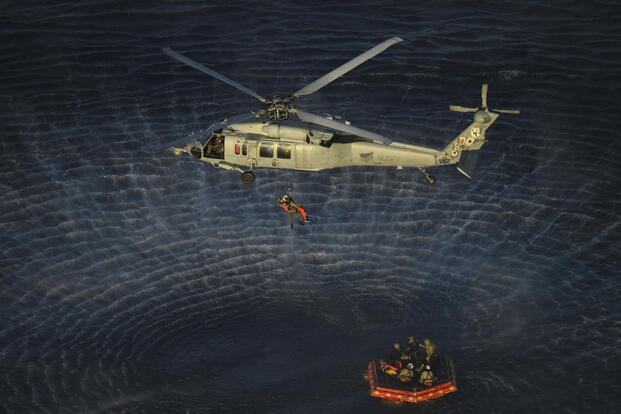
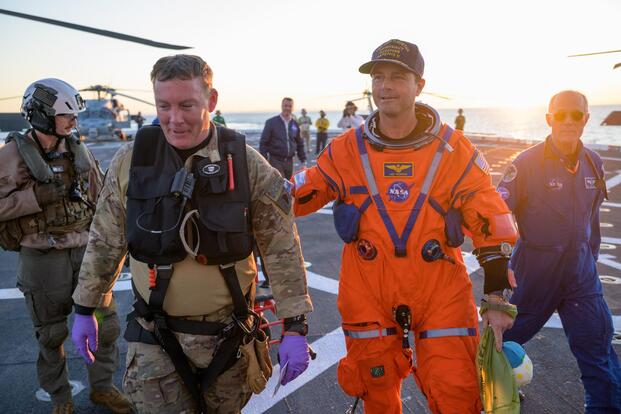
They also assisted the astronauts in egress onto an inflatable raft set up outside by the divers, who prepared the crew to be airlifted by Helicopter Sea Combat Squadron (HSC) 23 back to amphibious transport dock USS John P. Murtha (LPD 26) for follow on evaluations.
Wang, of Laguna Beach, Calif. And assigned to Explosive Ordnance Disposal Group 1, served as the lead. The board-certified emergency medicine doctor by trade, who completed residency training at Lincoln Hospital in Bronx, New York, joined the Navy in 2021 and was designated as an undersea medical officer in 2024.
“As a proud member of the undersea medical community, I am particularly humbled to play a part in this mission,” Wang said in a statement prior to Artemis’ return. “It is the honor of a lifetime to stand here today, ready to provide the absolute best care to the Artemis II crew.”
Aldridge, from Cushing, Okla., was the first member to make contact with the Artemis II crew. He opened the capsule and initiated medical assessments.
“Coming from three generations of military service in my family, I’m honored to serve as the senior dive independent duty corpsman for this mission,” Aldridge said in a statement. “This effort is the culmination of both our training to bring world class care to the Artemis II crew and countless dedicated years of Navy Diving and Navy medicine.”
Link, from Chelsea, Mass., has 18 years of dive medicine experience and said he’s proud to represent his family and hometown—saying the Navy’s contribution to the space mission “is something we take great pride in as part of that legacy.”
Kapala, from from Alpena, Mich., has practiced dive medicine since 2018 and understands the gravity around the mission.
“I grew up reading sci-fi novels and watching space movies, never thinking that I would play a part in a recovery mission like this,” Kapala said in a statement. “It is surreal to play a part in safely recovering the astronauts from the capsule to get them home safe to their families, an effort that really makes you realize this team is bigger than just the four of us.”
Read the full article here